Do I Need a Land Survey to Build a Fence?
Building a fence sounds simple enough. You pick a style, hire someone to install it, and that is that. But before the first post goes into the ground, there is one question worth asking: do you actually know where your property line is?
A fence in the wrong place is not just an awkward situation. It can become a legal problem that costs far more to fix than a survey ever would.
Virginia law does not require a land survey before building a fence. You can legally buy materials, hire a contractor, and install a fence without ever ordering one.
But whether that is a good idea depends entirely on how confident you are about where your property line actually sits. If there is any doubt at all, getting a survey first is almost always the smarter and cheaper choice.
What Virginia Law Says About Fences
Virginia Code sections 55.1-2820 through 55.1-2825 govern what are called partition fences. These are fences built on or along a shared property line between two neighboring properties.
Under Virginia Code Section 55.1-2821, adjoining landowners are generally required to build and maintain division fences between their lands, splitting the costs equally, unless one party agrees to something different in writing.
That matters for one important reason. If your fence ends up on the wrong line, even by accident, it can create shared legal obligations your neighbor never agreed to. It can also give them the right to demand you move it.
Some localities also require a permit before fence installation, and some of those permit applications ask you to show the fence location relative to your property lines. Without a survey or an accurate plat, you may not be able to prove your fence meets the local setback rules.
What Can Go Wrong Without a Survey
Encroachment
A fence that crosses onto a neighbor’s property, even by a few inches, is considered an encroachment. In Virginia, a property owner has the legal right to demand removal of any structure that encroaches on their land. That means tearing out what you built and doing it again, at your own expense.
Adverse Possession
This one surprises most homeowners. Under Virginia Code Section 8.01-236, a neighbor who openly and continuously uses a strip of your property for 15 years or more may be able to claim legal title to it. A fence placed in the wrong spot and left unchallenged for long enough can quietly cost you a portion of land you legally own.
Permit Problems
If your project requires a permit and the permit office asks for proof that your fence meets setback requirements, an old plat or a hand-drawn sketch usually will not satisfy them. A current survey from a licensed surveyor gives you the documentation you need.
When a Survey Is Strongly Recommended
Not every fence project needs a survey. But there are situations where skipping one is a real risk.
You should seriously consider ordering a survey before building a fence when:
- You have never had a survey done on the property
- Your existing survey is more than five to ten years old
- You do not know where your property corners are marked
- Your lot line runs close to a neighbor’s structure, driveway, or existing fence
- You and your neighbor disagree, even slightly, about where the line sits
- Your project is near an easement or utility corridor
According to a national survey by a fence industry research group, 16 percent of American homeowners have had a property line dispute with a neighbor. Encroachment from fences is one of the most common causes of those disputes.
What Type of Survey Do You Need?
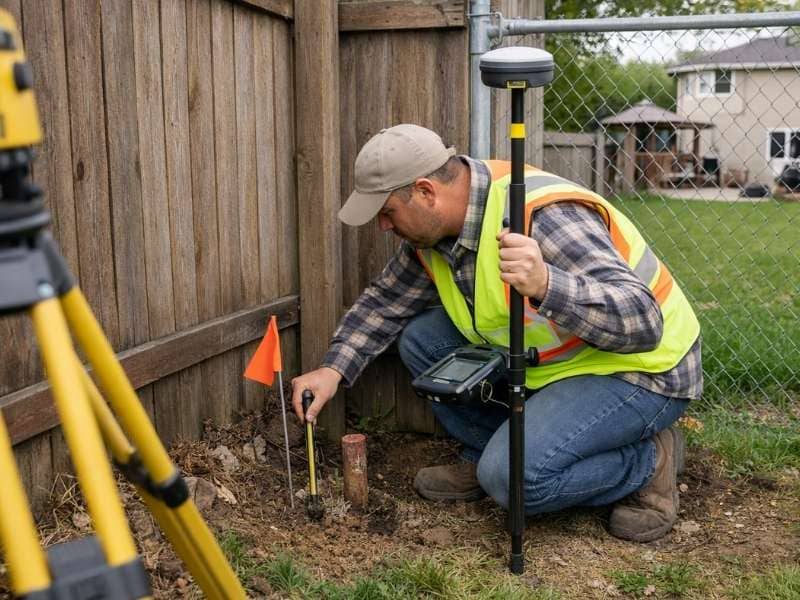
For fence installation, a boundary survey is the right choice. A boundary survey locates and physically marks your exact property corners and lines on the ground. That gives you a legally accurate starting point for placing your fence.
A topographic survey, which maps the slopes and drainage features of the land, is generally not needed for a fence project unless your lot has significant grade changes along the fence line that could affect drainage or structural design.
How Much Does a Fence Survey Cost?
A boundary survey for fence placement in Virginia typically costs between $400 and $800 for a standard residential lot. The final price depends on lot size, terrain, and how much existing documentation the surveyor has to work with.
To put that in perspective: tearing out a fence that was placed over the property line, rebuilding it in the correct location, and dealing with any legal back-and-forth with a neighbor can cost several times that amount. The survey pays for itself quickly when you consider what it prevents.
Frequently Asked Questions
Can I use my property deed instead of a survey?
A deed describes your property in legal terms, but it does not physically mark where your lines are on the ground. A licensed surveyor takes that legal description and translates it into actual markers you can see and use. The deed tells you what you own. The survey shows you where it is.
What if my neighbor and I agree on where the line is?
A verbal agreement between neighbors is not a legal boundary. If either property is ever sold, refinanced, or the subject of a dispute, what two people agreed to over a handshake carries no legal weight. A licensed survey is the only document that establishes the boundary with legal standing.
Do old surveys still count?
An older survey may still be valid if nothing on the property has changed and the corner markers are still in place. However, if markers have been moved, the land has been altered, or the survey is more than a decade old, a new one gives you the most reliable information.
Who pays for the survey when building a shared fence?
If both neighbors want the fence and want to share costs, splitting the survey cost is a reasonable arrangement. Virginia law requires equal cost-sharing for partition fences unless both parties agree otherwise, so starting the project with a clear and shared understanding of where the line sits benefits everyone involved.